Modern Persian Jewellery Designs for Women: A New Era of Silver & Symbolism

In the bustling creative hubs of London and Manchester, a quiet shift is transforming how the Iranian diaspora expresses identity. For decades, Persian jewellery was synonymous with high-carat, heavy gold pieces designed as much for financial security as for adornment.
But today, modern Persian jewellery designs for women have evolved. The heavy filigree of the bazaar is being replaced by something lighter, sharper, and distinctly contemporary. A new wave of designers, many based here in the UK, are reimagining ancient motifs through the lens of modern minimalism and material science.
This isn’t just about changing fashion; it is about a new generation claiming their heritage on their own terms. Here is how modern design is reshaping the Persian aesthetic.
Table of Contents
The “Deconstructed” Motif: A Design Revolution
The most significant trend in modern Persian jewellery is deconstruction. Traditional Iranian design often involves filling every millimetre of space with detail. Modern designs do the opposite: they rely on negative space and clean lines.
1. The Calligraphy of Air
Classical Persian jewellery often stamped poetry onto solid gold plaques. Modern designs, however, liberate the script.
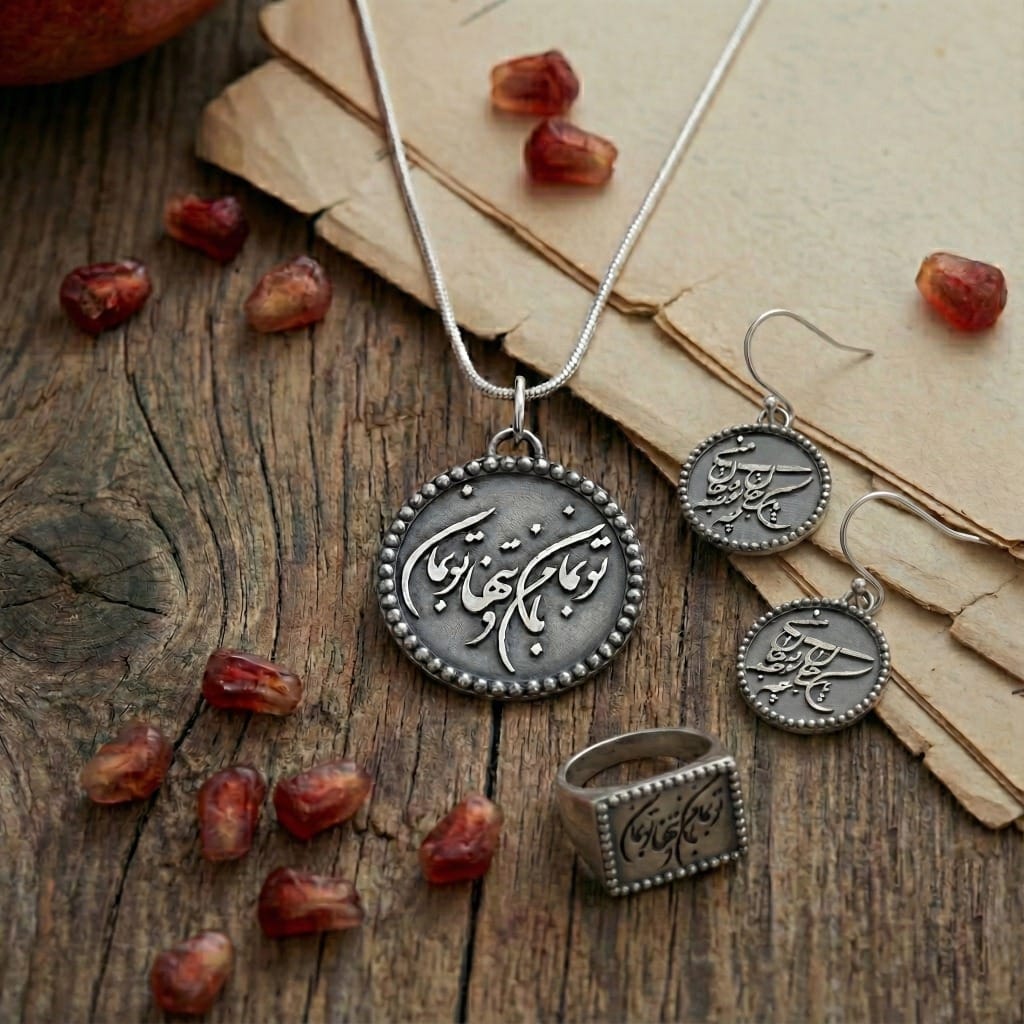
- The Technique: Instead of engraving, brands like Zar Jewellery use intricate casting techniques to create “floating” scripts. The letters are not just on the metal; they are the metal.
- The Effect: When worn, the skin becomes the canvas. The Nasta’liq script sits against the collarbone, making the poetry feel dynamic and alive rather than static.
2. The Skeletonised Pomegranate (Anar)
The pomegranate is iconic, but the modern version has shed its skin. Instead of heavy, gem-encrusted orbs, contemporary designers are creating “skeleton” structures—hand-finished outlines of the fruit in polished silver that suggest the shape without the weight.
- Why it works in the UK: This airy aesthetic pairs perfectly with the textured layers of British fashion—chunky knits and trench coats—where a solid gold piece might feel too heavy or “evening-only.”
The “Silver Shift”: Why Cool Tones Rule the UK Market
While gold remains the traditional standard in Iran, Sterling Silver has become the metal of choice for the modern UK diaspora. This is not a compromise on value; it is a specific aesthetic decision.
- The “Grey” Palette: The UK wardrobe is dominated by cool neutrals—charcoal, navy, slate, and black. Silver acts as a crisp highlighter against these tones, whereas yellow gold can sometimes clash or feel “too warm” for the grey British light.
- Material Honesty: There is a growing appreciation for the “honesty” of silver. It doesn’t try to be gold. Its bright, moon-like finish (especially when polished to a mirror shine) offers a futuristic edge to ancient symbols.
- Everyday Durability: For the modern woman commuting on the tube or working in a studio, Sterling Silver offers a resilience that soft 24ct gold cannot. It is a luxury meant to be lived in, not locked away.
Symbols of the “Third Culture”
Modern Persian jewellery designs for women often focus on symbols that bridge the gap between “Iranian roots” and “British life.” These motifs are chosen for their philosophical resonance rather than religious weight.
1. The Chalipa
Often mistaken for a simple geometric design, the Chalipa is one of the oldest symbols in Persian history, pre-dating modern religions.
- The Meaning: It represents the four elements (earth, water, air, fire) and the concept of “cosmic balance.”
- The Design: In modern collections (like Zar’s Chalipa Ring), this symbol is stripped back to its architectural roots. It creates a bold, structural look that feels almost like Bauhaus design, yet carries thousands of years of history. It is the perfect symbol for a woman seeking balance in a chaotic modern world.
2. The Poetry of Fereydoon Moshiri
While Rumi is famous globally, modern designers are digging deeper into contemporary Persian literature.
- The Trend: Specific verses from modern poets like Fereydoon Moshiri are appearing on signet rings and pendants.
- The Connection: A piece featuring the verse “Stay with me, and only you remain” is not just jewellery; it is a secret message. To the British observer, it is a beautiful abstract script; to the wearer, it is a line of beloved modern poetry that speaks of loyalty and presence.
3. The Paisley (Boteh) Reimagined
The Boteh is the origin of the worldwide “Paisley” print, representing the cypress tree—a symbol of resistance because it bends with the wind but never breaks.
- The Update: You will see Boteh shapes rendered in sleek, solid silver with matte finishes or delicate “Milgrain” (beaded edge) detailing. This turns a busy textile pattern into a serene, teardrop silhouette. It is a talisman for resilience.
4. The Shamse (Sun Motif)
Derived from the architectural domes of ancient Persia, the Shamse represents light and infinite multiplicity.
- The Look: Modern iterations, such as “Shamse” stud earrings, simplify this complex sunburst into a clean, radial geometry. It serves as a subtle “compass” or guiding light for the wearer, blending spiritual heritage with geometric fashion.
Styling: The “London Layering” Approach
Integrating cultural heritage into a Western wardrobe requires a delicate hand. The goal is contrast.
1. Texture Clash
Pair the fluid, organic curves of a Persian calligraphy pendant with a structured, industrial chain (like a box chain or paperclip link). The clash between the “soft” poetry and the “hard” chain is visually arresting.
2. The Narrative Stack
One of the most effective ways to style these pieces is by layering them with intention. A popular method involves balancing lengths and weights to ensure your meaningful pieces stand out without getting lost in a tangle.
For a detailed breakdown on how to perfectly space your necklaces, read our comprehensive guide on The 2-1-1 Layering Technique.
Why “Made in the UK” Matters
A hidden aspect of modern Persian jewellery is the fusion of Iranian artistry with British craftsmanship.
- Sustainability: Modern buyers are conscious of their footprint. Zar Jewellery, for instance, uses 100% recycled precious metals for its cast pieces. This adds a layer of “modern value” to the piece—it is not just culturally significant, it is ethically sound.
- Handcrafted Quality: Unlike mass-produced stamped metal, handcrafted pieces allow for smoother edges and more durable settings, ensuring the jewellery can withstand the wear and tear of a modern lifestyle.
Frequently Asked Questions
What Makes a Persian Jewellery Design “Modern”?
It is defined by simplification. Modern designs strip away the filigree and gem-encrusting of the past to focus on the line and shape of the symbol. It prioritises negative space, wearability, and often favours silver over gold.
Is Silver Jewellery Appropriate for Formal Persian Events?
Absolutely. The “Silver Renaissance” has elevated silver to a formal status. A highly polished, structural silver piece can make a bolder, more arthouse statement than traditional gold, especially when paired with black evening wear.
I Don’t Read Farsi. Can I Still Wear Calligraphy Pieces?
Yes. In the modern design world, Farsi calligraphy is appreciated as visual art. The curves of the script communicate grace and fluidity that transcends language. Many wearers choose pieces for the universal concepts they represent—like ‘Love’ or ‘Hope’—rather than the literal legibility.
How Do I Stop My Silver Persian Jewellery from Tarnishing?
Wear it! The natural oils in your skin actually help prevent tarnish. When not in use, store it in an airtight bag. If it does dull, the high quality of Sterling Silver means a quick wipe with a polishing cloth will restore it to “brand new” brightness instantly.