
The 2-1-1 Jewellery Styling Rule: An Editor’s Guide to Balance


We have all heard the old Coco Chanel adage: “Before you leave the house, look in the mirror and take one thing off.” It is elegant advice, but in the era of curated ear stacks and layered necklaces, it feels a bit vague. Take what off? The third ring? The hoop earrings?
Enter the 2-1-1 Jewellery Styling Rule.
Most stylists rely on this formula when a client feels “done up” but worries they look cluttered. It is the golden ratio of accessorising—a way to ensure your jewellery complements your outfit rather than competing with it. Whether you are dressing for a boardroom presentation or a Sunday brunch, this rule removes the guesswork from your morning routine.
Table of Contents
Key Takeaways: The 2-1-1 Rule at a Glance
- The Core Formula: The 2-1-1 Jewellery Styling Rule suggests wearing two pieces on the wrist/fingers, one statement piece near the face (such as earrings), and one on the décolletage (like a necklace).
- Visual Balance: This technique prevents the “Christmas Tree effect” by distributing visual weight evenly across your silhouette.
- Flexibility: It is a framework, not a law. It works best for office wear, first dates, and polished casual looks.
- Texture Over Quantity: When following this rule, mixing textures (e.g., a paved ring vs. a smooth band) adds depth without adding clutter.
What Is the 2-1-1 Jewellery Styling Rule?
The 2-1-1 Jewellery Styling Rule is a fashion formula designed to balance accessories. It dictates that an outfit should feature two items on the hands or wrists (rings or bracelets), one item on the neck (necklace), and one pair of items on the ears (earrings). This creates a triangle of visual interest that keeps the eye moving without overwhelming the viewer.
Why It Works: The Psychology of Visual Hierarchy
The human eye craves balance. When we see too much clustering in one area—say, chandelier earrings, a chunky choker, and a brooch—we experience visual fatigue.
The 2-1-1 rule works because it leverages triangulation.
- The “2” (Hands/Wrists): Since our hands are expressive and mobile, they can carry more “weight” (visual clutter) without distracting from the face.
- The “1” (Neck): This acts as an anchor.
- The “1” (Ears): This frames the face.
By spreading the adornment out, you look polished, not costumed.
How to Execute the 2-1-1 Rule Properly
1. The “2”: Curating Your Hands and Wrists
This is the fun part. The rule allows for two distinct points of interest on your arms. This could mean:
- A watch and a bracelet on one arm.
- A stack of rings on the right hand and a single bangle on the left.
- Two statement rings on separate fingers.
Stylist Tip: If you are wearing a busy print or a heavy knit, keep the “2” sleek.
2. The “1”: The Neckline Anchor
Your necklace choice must respect your neckline. The 2-1-1 rule demands that this is a singular focal point, not a messy tangle.
- V-Neck: Opt for a pendant that mimics the V shape.
- Crew Neck: A short chain or collar necklace sits best here.
- High Neck/Roll Neck: Go for a longer chain to elongate the torso.
The Exception: You can layer two very fine chains and count them as “one” visual unit, provided they are delicate.
3. The “1”: The Face Framers
If your necklace is bold, your earrings should be subtle (studs or huggies). If your necklace is a whisper-thin chain, you have permission to wear a bolder hoop or drop earring. The goal is to ensure the “1” on the neck and the “1” on the ears are talking to each other, not shouting over one another.
Real-World Scenarios: The Rule in Action
Scenario A: The Corporate Meeting
- The 2: A classic watch and a simple signet ring.
- The 1: A subtle pearl pendant or a thin gold snake chain.
- The 1: Small gold hoops.
- Why it works: It signals professionalism and attention to detail without being distracting during a presentation.
Scenario B: Weekend Brunch
- The 2: A stacked set of mixed-metal rings (think chunky gold mixed with silver).
- The 1: No necklace (letting the neckline breathe). Wait, does this break the rule? No—sometimes the “1” can be negative space (skin).
- The 1: Statement sculptural earrings.
Scenario C: Date Night
- The 2: Two delicate bracelets on the same wrist.
- The 1: A lariat necklace that draws the eye down.
- The 1: Diamond or crystal studs to catch the candlelight.
Styling in Practice: Zar Jewellery Examples
To illustrate the 2-1-1 jewellery styling rule effectively, it is helpful to look at brands that prioritise texture and detail, such as Zar Jewellery. Specialising in a blend of modern design and Persian heritage, the collection features recycled metals and semi-precious stones.
These pieces serve as an excellent case study for the 2-1-1 formula because they rely on narrative and craftsmanship rather than sheer volume. This allows for three distinct pieces to be worn simultaneously without the overall aesthetic feeling being cluttered or heavy.
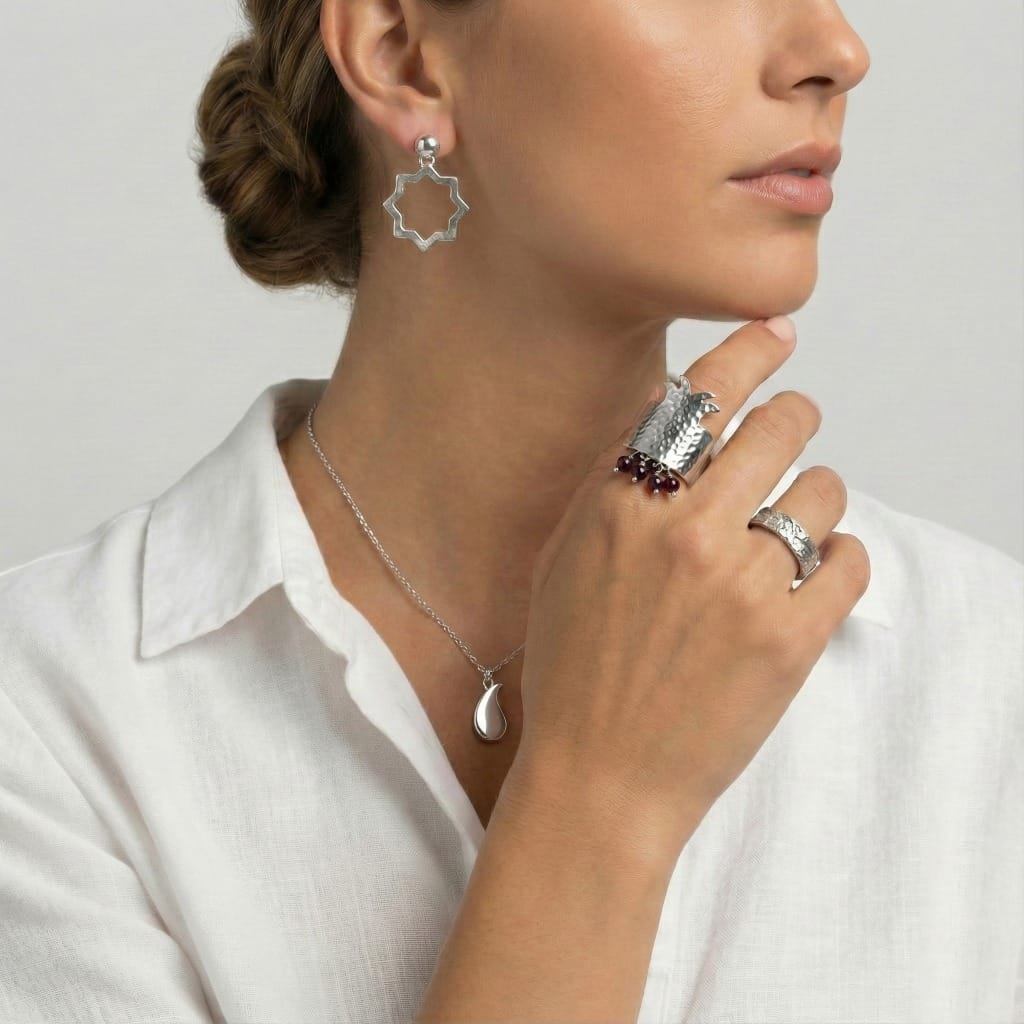
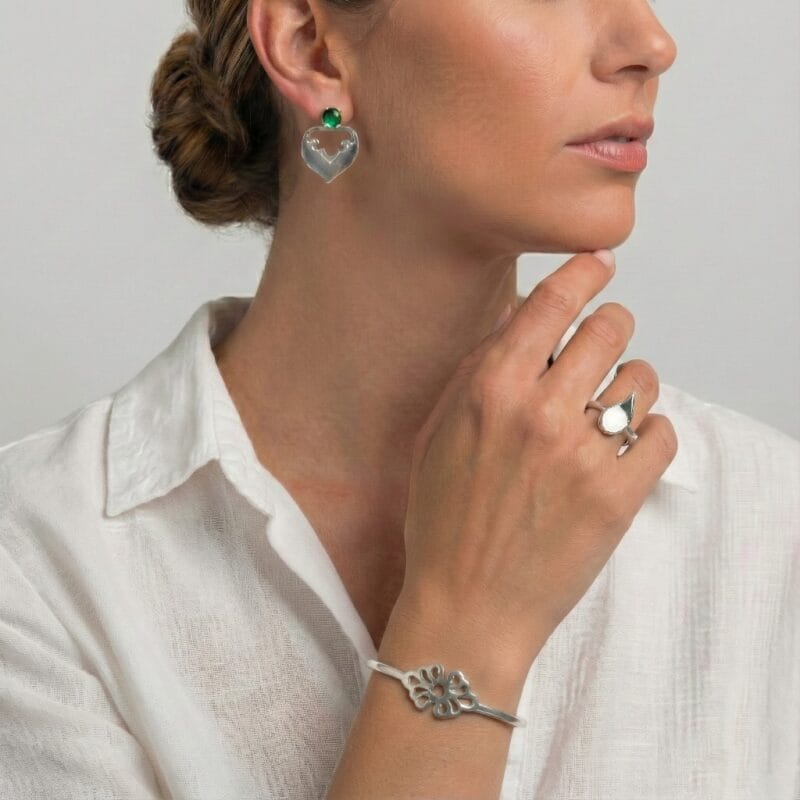
Here are two balanced 2-1-1 jewellery styling rule combinations using pieces from the collection:
Combination 1: The “Modern Heritage” Look
Best for: Professional settings or formal events. This combination balances intricate historical motifs with clean, modern silhouettes.
- The “2” (Hands):
- Piece A: Pomegranate Ring – A focal point piece featuring ruby-red stones, best placed on the dominant hand.
- Piece B: Organic Texture Open Ring – A simpler, gold vermeil band for the opposite hand to balance the complexity of the pomegranate design.
- The “1” (Ears):
- Piece: Shamse Stud Earrings – These sun-motif studs sit flat against the lobe. They frame the face elegantly without dangling, ensuring the focus remains on the wearer’s eyes.
- The “1” (Neck):
- Piece: To maintain the rule, a fine gold chain or a simple Paisley Pendant works best here, complementing the earth tones without competing for attention.
Combination 2: The “Organic Minimalist” Look
Best for: Daily wear or polished casual outfits. This look focuses on natural textures, green tones, and hammered metals.
- The “2” (Hands):
- Piece A: Paisley Ring – This intricate band features the classic boteh motif, adding cultural depth and texture to the hand without the bulk of a large stone.
- Piece B: Persian Motif Cuff Bracelet – A cuff is often a comfortable alternative to multiple rings for daily wear, sitting securely on the wrist.
- The “1” (Ears):
- Piece: Green Agate Persian Motif Earrings – These drop earrings coordinate with the ring, creating a cohesive “bookend” effect for the outfit.
- The “1” (Neck):
- Piece: In this scenario, skipping the necklace (utilising negative space) allows the drop earrings to stand out, or works well with a high-neck top.
When to Break the 2-1-1 Rule
Rules are essential for learning the basics, but mastery comes from knowing when to rebel. The 2-1-1 Jewellery Styling Rule is conservative by nature. You should intentionally break it when:
- Embracing Maximalism: If the aesthetic is “more is more” (think Iris Apfel styling), 2-1-1 will feel too sparse. In this case, layer neckmesses and wrist stacks freely.
- Cultural Attire: Many cultural traditional dresses (like South Asian bridal wear or Nigerian Aso Ebi) rely on opulence and abundance. Applying a minimalist 2-1-1 rule here would look underdressed.
- Statement Pieces: If you are wearing one massive, architectural piece of jewellery, let it stand alone. A 0-0-1 rule (just the earrings) is arguably the chicest move for a black-tie gown.
Common Mistakes to Avoid
- Ignoring Fabric Weight: Wearing heavy, chunky 2-1-1 jewellery with light, airy chiffon can drag the fabric (and the look) down.
- The “Matchy-Matchy” Trap: Wearing a necklace and earrings that are an exact matching set can look dated. It is better to coordinate styles (e.g., all modern geometric) rather than buying a pre-packaged set.
- Forgetting Practicality: If you type all day, having “2” heavy bangles clanging against your keyboard will drive you (and your colleagues) mad. Move the “2” to your rings or earrings instead.
Frequently Asked Questions (FAQs)
Does a wedding ring count towards the 2-1-1 Jewellery Styling rule?
Generally, no. Styling rules usually apply to fashion jewellery. Your wedding band and engagement ring are considered permanent fixtures—”skin” essentially. You can layer fashion rings on top of them, or count them as neutral.
Can I mix metals while using the 2-1-1 rule?
Absolutely. Mixing silver and gold is no longer a fashion faux pas; it is a sign of a modern eye. The key is to mix them in all zones. If you have a mixed metal ring stack (Zone 2), try a necklace that incorporates both metals to tie it together.
How does the rule change for high necklines?
With a high neck (turtleneck), the “Neck” element of the 2-1-1 rule becomes tricky. You can either wear a long pendant over the fabric, or skip the necklace entirely and double down on the earrings (making it a 2-0-2 balance).
Where can I find durable jewellery for the “2” hand stack?
Since rings and bracelets take the most physical wear, look for waterproof or PVD-coated gold pieces. Zar Jewellery is a strong option here, particularly for rings that withstand hand-washing and daily friction, ensuring your “everyday stack” doesn’t lose its lustre.
nice