
Symbolism in Persian Jewellery Art: A Cultural History


In the rich history of human decoration, few traditions are as meaningful as Persia. Symbolism in Persian jewellery art goes beyond looks; it tells a deep story through a visual language developed over thousands of years. For Persian artisans, gold was more than just a metal, and gems were not just random stones. They represented ideas of protection, divinity, power, and poetry.
To wear Persian jewellery is to engage with a history that predates the Silk Road. From the robust animal forms of the Achaemenid Empire to the delicate floral enamels of the Qajar dynasty, every clasp and curvature carries a coded meaning. At Zar Jewellery, we view these pieces not as inanimate objects, but as cultural manuscripts forged in fire and stone.
Table of Contents
The Historical Continuum: Eras of Meaning
Persian jewellery cannot be understood as a monolith. It is a palimpsest, overwritten by successive dynasties, religions, and artistic philosophies.
Pre-Islamic Majesty: The Achaemenid and Sassanian Influence
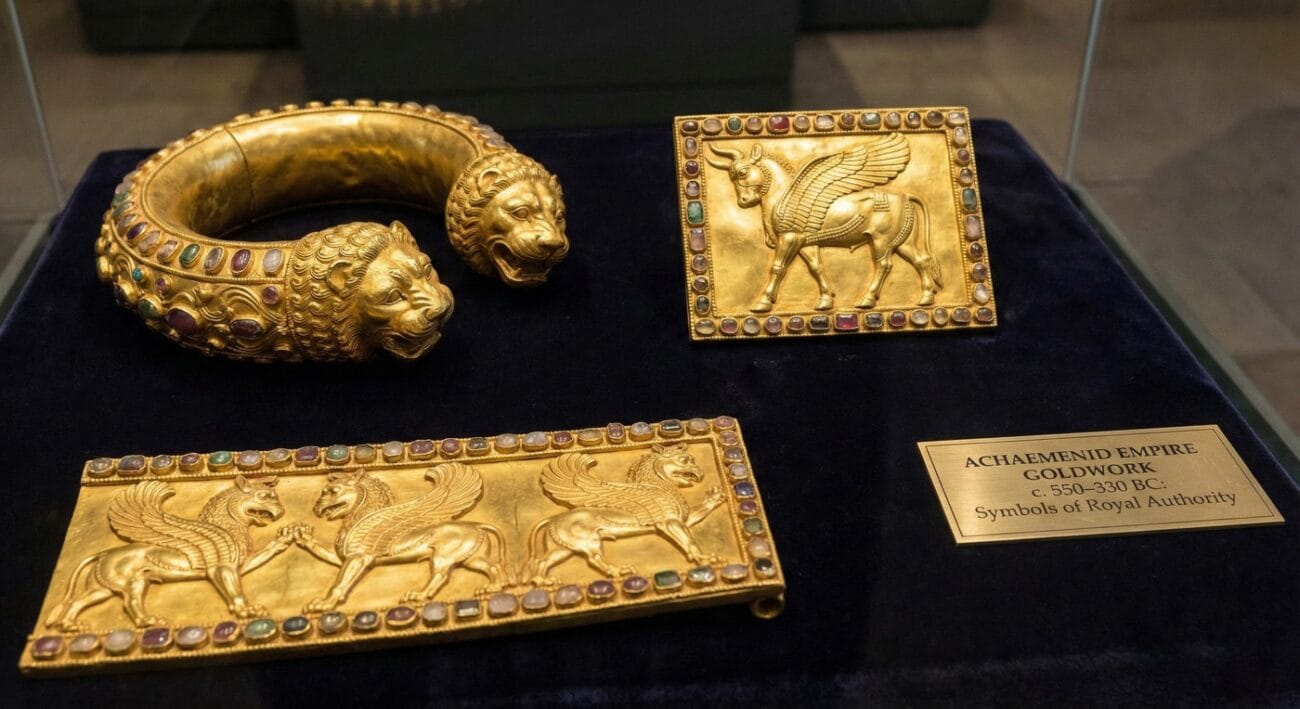
In the ancient world, jewellery served a dual purpose: it was a display of imperial might and a conduit for spiritual protection. The Achaemenids (c. 550–330 BC) favoured heavy, architectural gold work. Their symbolism was explicit—lions, bulls, and griffins were not decorative whims but potent talismans of strength and royal authority.
The Sassanian era (224–651 AD) refined this, introducing the concept of Khvarenah (Divine Glory). Jewellery became lighter, featuring granulation and the extensive use of pearls and garnets, symbolising the celestial light bestowed upon rightful kings.
The Islamic Transition: Geometry and The Word
With the arrival of Islam, the figurative representation of living beings became less common in public art, pushing symbolism into new, fascinating directions. The focus shifted toward:
- Geometric Abstraction: Infinite patterns representing the ungraspable nature of the Divine.
- Calligraphy: The written word became the ultimate art form.
The Safavid and Qajar Renaissance
The Safavid (1501–1736) and Qajar (1789–1925) periods marked a return to figurative exuberance. The Qajar artisans, in particular, mastered Minakari (enamel work), blending European painting techniques with Persian motifs. Jewellery became a canvas for romantic poetry, idealised portraits, and birds and flowers (Gol-o-Morgh), symbolising the earthly paradise.
Core Symbolic Motifs in Persian Design
To interpret symbolism in Persian jewellery art, one must learn to read its recurrent motifs. These symbols serve as a bridge between the wearer and the metaphysical world.
The Boteh (Paisley): The Cypress of Eternity
Perhaps the most globally recognised Persian motif, the Boteh Jegheh (known in the West as Paisley), is often misunderstood as a simple floral drop. Historically, it represents the Cypress tree—a Zoroastrian symbol of life and eternity. The cypress bends with the wind but never breaks, symbolising resilience and humility in the face of the divine.
Curator’s Note: In antique termeh textiles and jewellery alike, the Boteh often encapsulates a mother and child form, further associating it with fertility and generational continuity.
The Shah Abbasi Flower: The Royal Garden
Named after Shah Abbas the Great, this stylised lotus or palmette motif is the visual signature of the Safavid Golden Age. While prevalent in the famous carpets of Isfahan, in jewellery, the Shah Abbasi motif serves as a metaphor for the “Garden of Paradise.” It is characterised by complex, symmetrical floral patterns that symbolise royal abundance and spiritual blossoming. Unlike the wilder animal motifs of antiquity, the Shah Abbasi reflects a disciplined, cultivated beauty—perfect for intricate filigree and enamel work.
Discover the history of the Shah Abbasi Flower Motif
Shamse: The Radiance of Unity
Shamse (derived from the word for “Sun”) is a purely spiritual symbol. Visually, it appears as a star-shaped or circular medallion with radiating rays, traditionally used to open illuminated manuscripts. In jewellery, the Shamse represents Divine Unity —the concept that all existence emanates from a single, central creator. When worn as a pendant or brooch, it is not merely a symbol of the sun; it represents spiritual light and illumination.
Read more about the spiritual geometry of the Shamse: The Persian Sun Motif.
The Birds of Legend: Simurgh and Huma
Persian mythology is avian by nature.
- The Simurgh: A benevolent, mythical bird akin to the Phoenix. In jewellery, Simurgh motifs act as powerful amulets for protection and healing.
- The Huma: The “Bird of Paradise.” It is said that if the Huma’s shadow falls upon a person, they are destined for kingship. Stylised wings in pendants often reference this bestowal of fortune.
Materials as Meaning: The Lithotherapy of Persia
In Persian culture, the value of a gemstone is determined as much by its metaphysical properties as its clarity or carat weight.
Turquoise (Firoza): The Stone of Victory
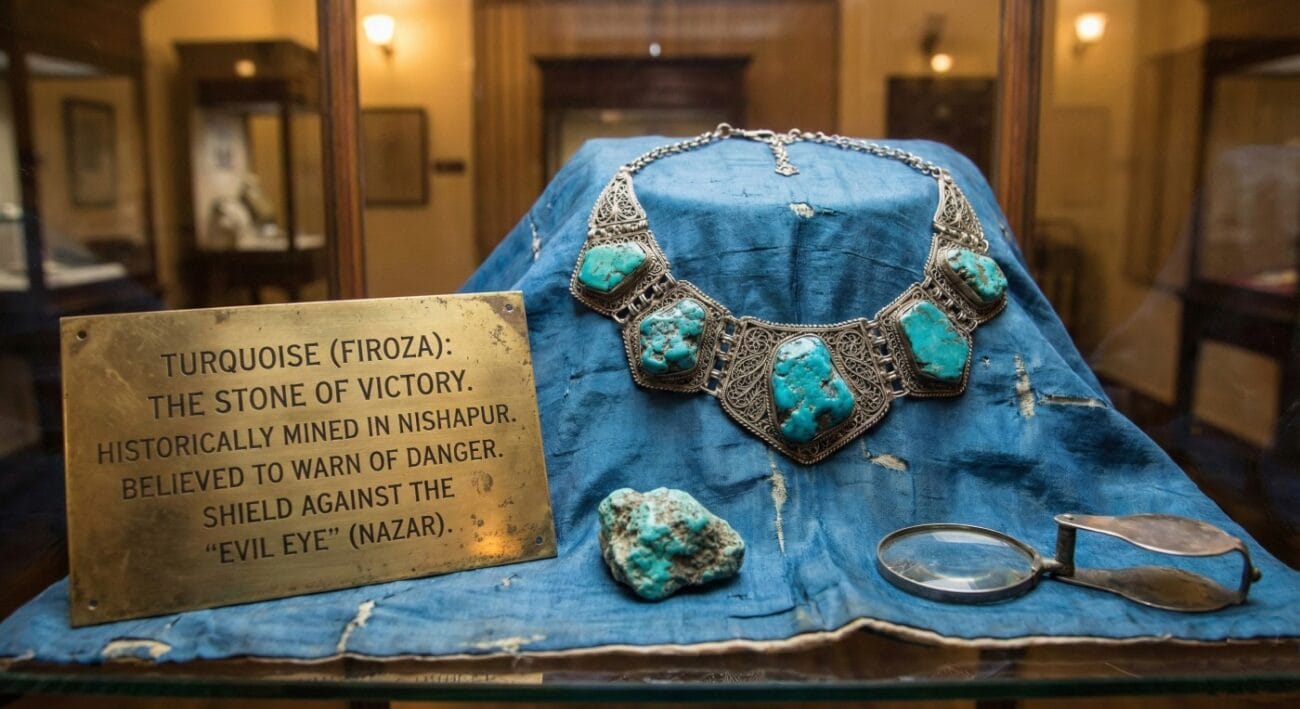
No stone is more synonymous with Persia than Turquoise. The name Firoza translates to “Victory.” Historically mined in Nishapur, it was believed to change colour to warn the wearer of impending doom. It is the ultimate shield against the “Evil Eye” (Nazar). In architecture and jewellery alike, its blue-green hue connects the earth to the vastness of the heavens.
Lapis Lazuli: The Night Sky
Mined in the region for thousands of years, Lapis Lazuli—with its gold pyrite flecks resembling stars in a dark blue sky—symbolises the heavens and infinite wisdom. It was often ground down to create pigment for manuscripts but was equally prized in bead and inlay work for its connection to truth and intellect.

Symbolism in Modern Persian Jewellery
Contemporary designers are not merely replicating the past; they are reinterpreting it. Symbolism in Persian jewellery art today is about identity.
The diaspora and modern Iranians alike wear these symbols as anchors. A calligraphy necklace bearing a verse from Rumi is no longer just a religious talisman; it is a declaration of cultural pride. The Faravahar (the winged symbol of Zoroastrianism) is worn to signal a connection to ancient Persian roots and the principle of “Good Thoughts, Good Words, Good Deeds.”
Zar Jewellery: Custodians of the Motif
At Zar Jewellery, our design philosophy is one of deconstruction and reverence. We do not simply replicate the heavy filigree of the bazaar; we distil ancient motifs into their purest, architectural forms for the modern wearer.
Our Persis collection is curated to serve as “wearable manuscripts”—pieces that carry the weight of Persian history while fitting seamlessly into a contemporary life.
The Calligraphy Collection: Poetry in Suspension
[Link to Collection: Persian Poem Calligraphy Pendant] The most direct link to Persian culture is the language. Our Persian Poem Calligraphy Pendant features the Nasta’liq script, but with a crucial modern twist. Instead of engraving the text onto a solid plaque, we “skeletonise” the script. The metal is the word.
Symbolism
This design represents the “liberation” of tradition. The negative space allows the wearer’s skin to show through, symbolising that the culture is alive and breathing, not trapped in a museum case.
Key Piece
The “Stay with me, and only you remain” pendant, inspired by the modern poetry of Fereydoon Moshiri, transforms a declaration of love into a structural art form.
The Chalipa Ring: Cosmic Balance
Chalipa Ring Often mistaken for a simple geometric cross, the Chalipa is a pre-Zoroastrian symbol representing the four elements (Earth, Water, Air, Fire) and the intersection of the physical and spiritual worlds.
Design Philosophy
Our Chalipa Ring strips away ornamentation to reveal the symbol’s stark, architectural power. It creates a bold, Bauhaus-like silhouette that speaks to the ancient Persian obsession with cosmic order and symmetry.
The Pomegranate (Anar) Ring
Pomegranate Ring In Persian mythology, the pomegranate symbolises fertility, abundance, and the crimson glow of life itself.
Modern Interpretation
Rather than a realistic fruit, our Anar Ring uses a “skeletonised” frame. It captures the idea of the pomegranate—its fullness and curves—without the visual weight.
Cultural Context
This piece is a nod to Yalda Night (the winter solstice), where pomegranates are eaten to celebrate the triumph of light over darkness.
The Milgrain Paisley (Boteh) Collection
Milgrain Paisley and Oval Green Agate Ring. As discussed in the historical section, the Boteh is the cypress of eternity.
The Detail
We use milgrain (tiny beaded edges) to mimic the texture of antique Termeh textiles. Paired with Green Agate—a stone of vitality—this ring bridges the gap between textile history and metalwork.
Symbolism
It serves as a reminder of resilience: the ability to bend with the wind but never break.
Key Takeaways
- Function over Form: Ancient Persian jewellery was primarily talismanic, designed to offer protection (Simurgh) or signal authority (Lions).
- The Boteh: Often called Paisley, this motif represents the resilient Cypress tree and eternal life.
- Colour Philosophy: Turquoise (Firoza) is the paramount Persian gem, representing victory and protection against the Evil Eye.
- Calligraphy: In the Islamic era, beautiful writing (Nasta’liq) transformed language into visual art, often replacing figurative images.
Frequently Asked Questions (FAQs)
What is the most famous symbol in Persian jewellery?
The Boteh Jegheh (Paisley) is the most widely recognised symbol. It represents the cypress tree, signifying life, eternity, and resilience.
Why is turquoise so important in Persian culture?
Turquoise, or Firoza (meaning Victory), is considered the national stone of Iran. It is historically believed to protect the wearer from the “Evil Eye” and bring good fortune. The mines of Nishapur produce the most prized “robin’s egg blue” variation.
What is the meaning of the Simurgh in jewellery?
The Simurgh is a mythical bird from Persian folklore, similar to a Phoenix. In jewellery design, it symbolises healing, protection, and immense wisdom. It is often depicted as a winged creature integrated into intricate gold work.
Did religion change Persian jewellery styles?
Yes. With the advent of Islam, realistic depictions of humans and animals became less common in public art. This led to a flourishing of geometric patterns and calligraphy in jewellery, transforming script into a primary decorative element.
Conclusion
The study of symbolism in Persian jewellery art reveals a profound truth: we adorn ourselves not to hide who we are, but to articulate it. From the protective gaze of a turquoise stone to the poetic curve of a calligraphy pendant, these pieces act as a dialogue between the wearer, their heritage, and the divine.
As we move forward in a digital age, these ancient symbols ground us. They remind us that beauty, when rooted in meaning, is timeless.
For further academic reading on Persian art history, we recommend visiting the collections of the British Museum or the Louvre Department of Islamic Art.