

Blog
Persian Yalda Food: Traditional Foods, Flavours and the Meaning Behind the Yalda Table


There is something particularly memorable about the food served on Shab-e Yalda. The table is often filled with deep red pomegranates, bright watermelon, bowls of nuts and dried fruit, Persian sweets, tea and, depending on the family, a warm dinner prepared especially for the evening. Yet Persian Yalda food is about much more than what is placed on the table. It is part of the atmosphere of the night: a way of bringing people together, sharing abundance and keeping the longest night of the year warm with conversation, poetry and family.
Yalda, also known as Shab-e Yalda or Shab-e Chelleh, takes place around the winter solstice and has been celebrated across Persian culture for generations. The tradition is closely associated with the idea of light returning after the longest night, which helps explain why the table is traditionally filled with colourful fruits, candles or lamps, sweets and other foods that create a sense of warmth and abundance. UNESCO describes Yaldā/Chella as a traditional celebration of the sun and the warmth of life and inscribed it on the Representative List of the Intangible Cultural Heritage of Humanity in 2022. UNESCO: Yaldā/Chella
Table of Contents
The Yalda Table: More Than a Meal
A traditional Persian Yalda table, sometimes referred to as a Sofreh-ye Yalda, is usually arranged with a mixture of foods, fruits and symbolic objects. There is no single menu that every Persian family follows, and the exact foods can vary according to region, family traditions and personal taste. What remains remarkably consistent is the feeling behind the table: generosity, colour, hospitality and the pleasure of sharing food together.
This is one reason Yalda food feels different from an ordinary family dinner. Even simple ingredients can become meaningful when they are prepared for a night that has such a strong cultural identity. The table becomes part of the celebration itself, with family members gathering around it to eat, talk, drink tea, read poetry and, in many homes, stay awake well into the night.
UNESCO’s description of Yaldā/Chella highlights this connection between food and family gathering, noting that families traditionally gather around a table decorated with symbolic objects and foods, including red fruits such as pomegranates and watermelons. Read the UNESCO description of Yaldā/Chella
Pomegranate: The Fruit Most Closely Associated with Yalda
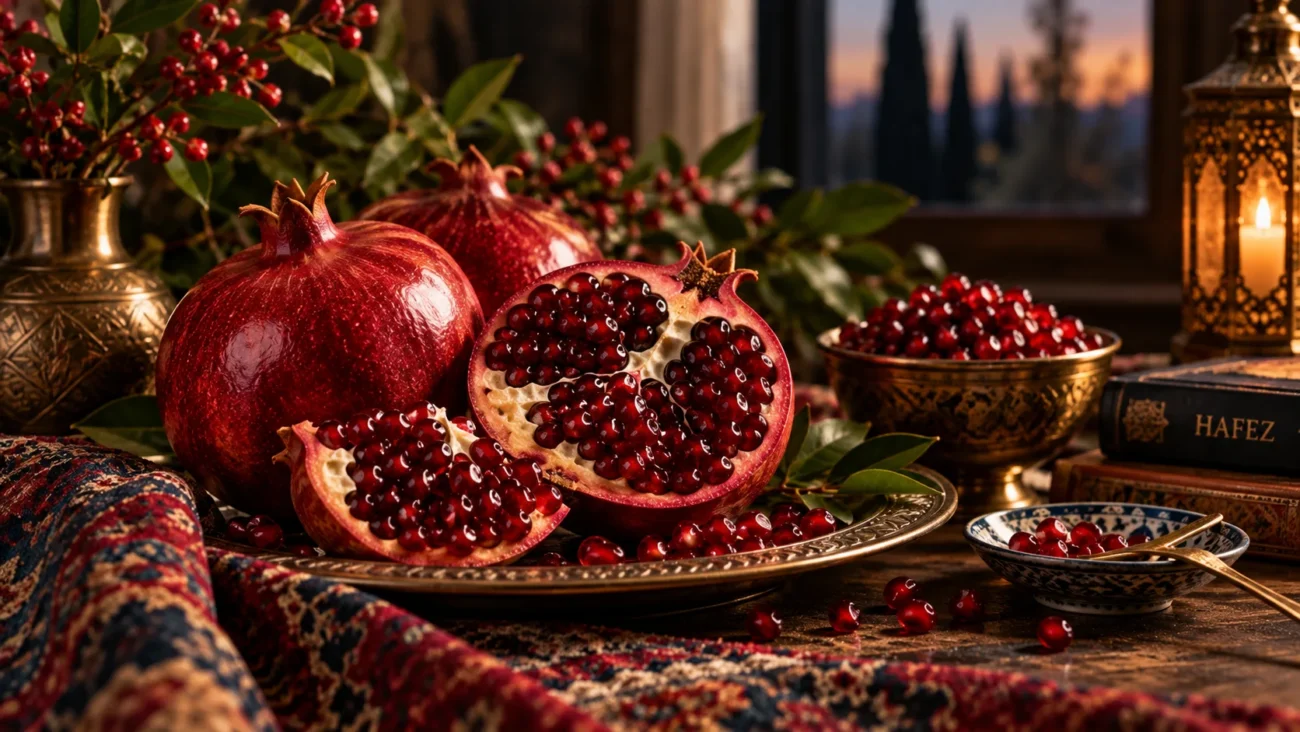
If there is one fruit that immediately brings Yalda Night to mind, it is the pomegranate. Known as anar in Persian, the fruit is particularly striking on a winter table because of its deep red colour and jewel-like seeds. When opened and placed in a bowl, a pomegranate almost looks like a natural piece of jewellery, which may be one reason it has such a strong visual presence in Persian art and design.
The symbolism of the pomegranate extends far beyond Yalda itself. Its abundance of seeds has long made it an important cultural image associated with fertility, prosperity, abundance and life. During Yalda, however, its bright red colour also fits beautifully with the wider themes of warmth and vitality that surround the celebration.
The pomegranate has naturally become an important source of inspiration for contemporary Persian jewellery. At ZAR Jewellery, for example, the Pomegranate Ring takes the recognisable form of the fruit and translates it into a contemporary sterling-silver design. The result is a piece that references Persian cultural symbolism without feeling like a seasonal decoration, so it can be worn and appreciated throughout the year.
You can also read more about the cultural meaning of the fruit in our article Yalda Night Symbols: The Meaning Behind Pomegranates, Poetry & Light.
Watermelon and the Colours of the Yalda Table
Watermelon is another familiar feature of traditional Yalda food, and its appearance on a winter table can seem surprising to people unfamiliar with the tradition. The contrast between its green exterior and bright red interior makes it one of the most visually distinctive foods associated with the celebration.
For many Persian families, watermelon is simply part of the familiar taste and atmosphere of Yalda. It is sliced and shared among family members, often appearing alongside pomegranates, nuts and other seasonal foods. Like the pomegranate, its strong red colour contributes to the sense of warmth and vitality that runs through the Yalda table.
The importance of these fruits is not simply decorative. UNESCO’s description of Yaldā/Chella specifically includes pomegranates and watermelons among the red fruits traditionally associated with the celebration, alongside other foods such as beetroot, jujube and grapes. This makes the colourful fruit display an important part of the wider cultural tradition rather than simply a modern styling choice.
Ajil: Nuts and Dried Fruits for Sharing
No discussion of Persian Yalda food would feel complete without Ajil. A mixture of nuts and dried fruits, Ajil is a familiar part of Persian hospitality and is particularly well suited to an evening when people are sitting together for hours.
Depending on the household, an Ajil mixture might include pistachios, almonds, walnuts, hazelnuts, raisins, dried berries, dried apricots and other ingredients. There is considerable variation between families, and that flexibility is part of what makes the tradition feel personal rather than prescriptive.
Ajil also fits naturally with the social character of Yalda. Rather than being a dish served once and finished, it can remain on the table throughout the evening, allowing people to take a little while they are talking, drinking tea or listening to poetry. It is food designed for sharing and conversation, which is exactly the atmosphere Yalda encourages.
Persian Sweets and the Pleasure of a Long Evening
Persian sweets often add another layer of colour and hospitality to the Yalda table. Depending on the family and region, the selection might include traditional pastries, saffron-based sweets, dried fruits, dates or other favourite treats. There is no universal Yalda dessert, and many families simply serve the sweets that have become part of their own family tradition.
That personal element is important. Yalda is not about following a strict menu; it is about recreating an atmosphere that feels familiar. A particular sweet may remind someone of their grandmother’s house, childhood Yalda celebrations or evenings spent with relatives, making even a simple plate of sweets part of a much larger family memory.
What Do Persian Families Eat for Yalda Dinner?
The fruit and sweets may be the most recognisable part of the Yalda table, but many families also prepare a proper dinner. What is served can vary considerably from one household or region to another, so there is no single dish that should be described as the definitive Yalda dinner.
Some families prepare rice dishes, stews or other traditional Persian meals, while others keep the evening simpler and focus on the fruits, nuts, sweets and tea. In some homes, Yalda dinner is an elaborate family meal; in others, the emphasis is more strongly placed on sitting together and enjoying the foods that can be eaten throughout the evening.
One dish that is sometimes associated with special Persian gatherings is Fesenjan, a rich stew made with ground walnuts and pomegranate molasses, usually served with rice. Its deep flavour and use of pomegranate make it particularly appropriate for a Yalda-inspired meal, although it is important not to suggest that every Persian family traditionally serves Fesenjan specifically for Yalda.
The variety itself is part of the tradition. Persian food culture has always been strongly regional and family-based, and Yalda reflects that diversity rather than replacing it with one fixed menu.
Persian Tea: The Drink That Keeps the Evening Going
Tea has an important place in Persian hospitality, and a Yalda gathering is a natural occasion for the samovar or teapot to remain busy throughout the evening. After dinner and alongside fruit, nuts and sweets, glasses of Persian black tea give family members another reason to linger around the table.
The role of tea at Yalda is therefore not simply about the drink itself. It is part of the rhythm of Persian hospitality: someone pours another glass, a conversation continues, a plate of fruit is passed around and eventually someone suggests reading another poem.
That slow pace is one of the things that makes Yalda so different from celebrations that revolve around a single meal. The evening is deliberately unhurried, giving people time to talk, remember, laugh and enjoy one another’s company.
Yalda, Poetry and Fal-e Hafez
Food is only one part of the Yalda experience. Once everyone has eaten and the tea is flowing, many Persian families turn to poetry, storytelling and Fal-e Hafez, the tradition of opening the poetry collection of Hafez and interpreting the poem as a kind of personal omen or reflection.
This combination of food and poetry is one of the most beautiful aspects of Yalda. The table provides the physical warmth of fruit, nuts, tea and sweets, while poetry adds another kind of nourishment. A pomegranate can be passed around the table, tea can be poured, and a poem can suddenly become the centre of everyone’s attention.
For a celebration that takes place on the darkest night of the year, there is something particularly fitting about surrounding the evening with words, colour, conversation and light.
You can explore this connection further in ZAR’s article What Is Yalda Night? History, Meaning and Traditions, which looks at the wider cultural background of the celebration.
The Historical Connection Between Yalda and the Winter Solstice
Yalda’s relationship with the winter solstice is an important part of understanding why the celebration has such a strong emphasis on darkness and light. In Persian tradition, the night represents the turning point after which the days gradually begin to become longer again.
The Encyclopaedia Iranica provides a valuable scholarly discussion of the historical traditions surrounding the Persian winter calendar. Its article on the Sada Festival discusses the winter solstice, Shab-e Yalda and Shab-e Chella, noting that the winter-solstice night was known as Shab-e Yalda and described as the longest and darkest night of the year.
This is a useful historical source to cite when discussing the background of Yalda rather than the specific food traditions. For a more detailed regional discussion, Encyclopaedia Iranica’s Folklore of Khorasan also describes Shab-e Yalda gatherings in which families consumed fruits and nuts together through the night.
Why Food Matters So Much at Yalda
Food has a special ability to carry cultural memory from one generation to another. Someone may forget the exact words spoken at a Yalda gathering years ago, but remember the smell of tea, the sound of pomegranate seeds being separated into a bowl, the taste of a particular sweet or the way their family arranged the table.
That is why Persian Yalda food should not be understood simply as a collection of traditional ingredients. The food represents hospitality, family connection and continuity. It turns an ancient seasonal celebration into something tangible that can be recreated in a modern home, even when families are living far from Iran.
For Persian families living abroad, this can be especially meaningful. A Yalda table in London, Toronto, Los Angeles or elsewhere may look slightly different from one in Iran, but the familiar combination of food, family and conversation can still create a strong connection with Persian heritage.
Creating a Yalda Table at Home
You do not need a huge dinner or an elaborate decoration to create a meaningful Yalda table. A few pomegranates, watermelon, Ajil, Persian sweets and a pot of tea can immediately create the visual and sensory character of the celebration, particularly when the table is prepared with care.
What matters most is bringing people together around it. Add some candles or warm lighting, place the fruit in attractive bowls, prepare a favourite family dish and leave plenty of time for conversation. If you enjoy Persian poetry, keep a copy of Hafez nearby and make the evening about the experience rather than trying to create a perfectly styled table.
The same principle applies to gifts. A Yalda gift does not need to be expensive or extravagant to be meaningful; the best gifts are often those that carry a connection to Persian culture or to a memory shared between the giver and recipient.
For more ideas, see Yalda Night Gift Ideas: Meaningful Persian Gifts.
From the Yalda Table to Persian Jewellery
There is a natural connection between the food on a Yalda table and the symbolism found in Persian jewellery. A pomegranate, for example, can be enjoyed as fruit on the table while also serving as an artistic motif that carries ideas of abundance, life and heritage into something that can be worn.
This is where a cultural gift can become particularly meaningful. Rather than buying something that is simply associated with a particular date, choosing jewellery inspired by Persian symbols allows the recipient to carry a small part of that cultural story long after the Yalda gathering has ended.
ZAR Jewellery explores this idea through contemporary pieces inspired by Persian heritage, nature and symbolism. The Pomegranate Ring is an obvious connection to the Yalda table, while the Pomegranate with Red Garnet Stones offers another interpretation of the same powerful motif. For someone drawn more strongly to Persian literature and poetry, the Persian Poem Signet Ring provides a different connection to the cultural traditions celebrated during Yalda.
The aim is not to turn an ancient celebration into a shopping occasion. Instead, a thoughtfully chosen piece of jewellery can become another way of preserving the meaning behind the celebration and carrying that connection into everyday life.
Persian Yalda Food Is About Memory as Much as Tradition
The beauty of Yalda is that there is no single perfect table. One family may prepare an elaborate dinner, another may gather around fruit, nuts and tea, while another may combine Persian traditions with foods that have become part of their own family’s life abroad.
What connects these different celebrations is the act of gathering together. Pomegranates, watermelon, Ajil, sweets, tea and traditional dishes all contribute to the atmosphere, but the real meaning of the Yalda table comes from the people sitting around it.
That is why Persian Yalda food remains such an important part of the celebration. It transforms the longest night of the year into an evening of colour, warmth, generosity and shared memory — a tradition that continues to evolve while retaining its connection to Persian heritage.
Make This Yalda More Than a Celebration for One Night
A beautiful Yalda table disappears by the end of the evening, but the memories created around it can last for years. A meaningful piece of Persian jewellery can offer another way to preserve that connection, turning a familiar symbol such as the pomegranate or Persian poetry into something personal that can be worn long after the last Yalda tea has been poured.
Frequently Asked Questions
What foods are traditionally eaten on Yalda Night?
Traditional Yalda food commonly includes pomegranates, watermelon, nuts, dried fruits, Ajil, Persian sweets and tea. Many families also prepare a full Persian dinner, although the dishes vary considerably according to regional and family traditions.
Why is pomegranate important on Yalda?
Pomegranate is one of the most recognisable Yalda foods because of its vivid red colour and longstanding cultural associations with warmth, life and abundance. Its jewel-like seeds have also made it an important visual symbol of the Yalda table.
Why do Persians eat watermelon on Yalda?
Watermelon has traditionally been associated with Yalda despite being a summer fruit. Traditional beliefs have connected eating it with protection from winter cold and illness, while its bright red colour also makes it a natural part of the Yalda table.
What is Ajil?
Ajil is a Persian combination of nuts and dried fruits. There is no single recipe, and families often create their own mixtures using ingredients such as pistachios, almonds, walnuts, raisins, figs and other dried fruits.
Is there a special Yalda dinner?
There is no single dinner that all Persian families eat on Yalda. Different regions and families have their own traditions, and dishes such as Fesenjan, Ash, Abgoosht and various rice dishes may be served alongside the more familiar Yalda fruits and snacks.
Do Persian families celebrate Yalda outside Iran?
Yes. Yalda continues to be celebrated by Persian communities around the world, including families living in the UK, Canada, the United States and Europe. Many families adapt traditional foods and customs to their modern surroundings while maintaining the central idea of gathering together.