

Blog
What Is Yalda Night? History, Meaning and Traditions


If you’ve ever wondered what is Yalda Night, you may have heard it described simply as the Persian celebration of the winter solstice. That description is accurate, but it doesn’t quite capture what the occasion means to the people who celebrate it. For many Persian families, Yalda is a night of gathering, conversation, food, poetry and family, turning the longest night of the year into an occasion that feels warm rather than dark.
Known as Shab-e Yalda or Shab-e Chelleh, Yalda takes place around the winter solstice, when the Northern Hemisphere experiences its longest night and shortest day. Families traditionally gather together, share seasonal foods, read poetry and tell stories, often staying awake late into the night. Pomegranates and watermelon bring colour to the table, while the poetry of Hafez provides another reason for people to pause, reflect and talk. UNESCO recognised the importance of the tradition by inscribing Yaldā/Chella on its Representative List of the Intangible Cultural Heritage of Humanity in 2022. UNESCO — Yaldā/Chella
If you’re celebrating Yalda and are also looking for a thoughtful present, our guide to Yalda Night gift ideas explores meaningful Persian-inspired gifts, including jewellery connected with the symbolism of the celebration.
Table of Contents
What is Yalda Night?
Yalda Night is a traditional Persian celebration associated with the winter solstice, marking the transition from autumn into winter. The solstice itself is an astronomical event experienced across the Northern Hemisphere, but Yalda gives that natural turning point a distinctive cultural meaning by bringing people together to mark it.
There is no official programme that every family follows. One household might prepare an elaborate meal and spend hours reading Hafez, while another might simply gather for dinner, eat pomegranates and watermelon, talk late into the evening and enjoy being together. The details vary according to family, region and circumstance, but the underlying idea remains remarkably consistent: the longest night of the year becomes an opportunity to connect.
For Persian families living outside Iran, including those in the UK, that sense of connection can be particularly important. Yalda can provide a moment when several generations come together and share customs that might not otherwise form part of everyday life.
Why do Persians celebrate Yalda?
The winter solstice represents a natural turning point. It is the longest night of the year, but it also marks the point after which daylight gradually begins to increase. That movement from darkness towards light has given the celebration a powerful symbolic quality, with ideas of hope, renewal and the continuation of life becoming closely associated with Yalda.
The symbolism is perhaps most apparent when you consider the way the celebration is experienced. Nobody expects winter to disappear the following morning, and the first days after the solstice are still cold and dark. Instead, Yalda acknowledges that change can begin quietly and gradually. The days become a little longer, and eventually the difference becomes unmistakable.
This idea has helped Yalda remain meaningful long beyond its original seasonal context. The celebration is not simply about observing an astronomical event; it is about gathering together at a moment that naturally lends itself to reflection and optimism.
When is Yalda Night?
Yalda is celebrated around the winter solstice, usually on the evening of 20 or 21 December. The exact date can vary slightly from year to year because the astronomical solstice does not occur on precisely the same Gregorian calendar date every year.
Traditionally, Yalda is regarded as the final night of autumn and the beginning of winter. For people living in Britain, where December brings early sunsets and some of the shortest days of the year, the idea behind the celebration can feel particularly tangible. The darkness arrives early, and the appeal of gathering somewhere warm with family and friends is easy to understand.
What does the name Yalda mean?
The word Yalda comes from Syriac and is generally understood to mean “birth”. Its association with the winter solstice has led to interpretations connecting the name with the birth or renewal of the sun and the return of light.
The name is only one part of the tradition, however. For people celebrating Yalda today, its meaning is often expressed through family relationships, cultural memory and the simple act of making time for one another. A grandparent may remember celebrating Yalda as a child, while their grandchildren may now be continuing the tradition in another country and in a completely different setting.
The surroundings may change, but the significance can remain.
The history behind Yalda Night
Yalda’s history is connected with the long cultural history of the Iranian world and ancient traditions concerning seasonal change, the sun and the contrast between light and darkness. However, it is worth avoiding overly simple claims that present the modern celebration as an unchanged survival of one specific ancient ceremony.
Like many traditions that have existed for centuries, Yalda has evolved. Different communities have developed their own customs, while later Persian literary and social traditions have added further layers of meaning. Some elements may have ancient roots, while others became prominent much later.
What has endured is the broader tradition of marking the winter solstice through gathering, food, storytelling and cultural expression. That continuity is arguably more interesting than the idea of a celebration frozen in time. Yalda remains relevant because successive generations have found their own way to make it part of family life.
Why are pomegranates associated with Yalda?
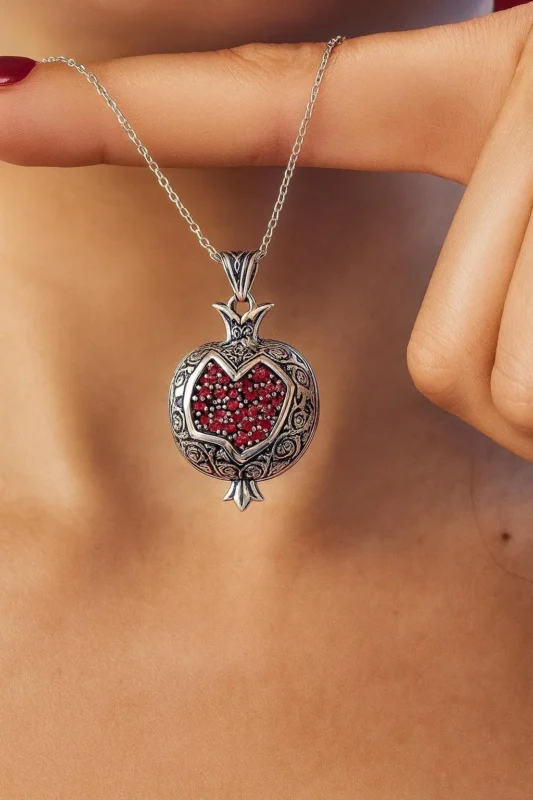
Pomegranates are among the most recognisable symbols of Yalda. Their deep red colour creates a striking contrast with the darker atmosphere of a winter evening, while the fruit itself has a long and important presence in Persian art, literature and cultural symbolism.
During Yalda, pomegranates are commonly placed on the table and shared among family and friends. Their connection with the occasion has also made them a natural source of inspiration for contemporary design, including jewellery.
For example, ZAR Jewellery’s Pomegranate Ring interprets the distinctive form of the fruit through contemporary sterling-silver jewellery. The design references a familiar element of Persian culture without making the piece look like a seasonal ornament, which means it can be worn long after Yalda has passed.
The symbolism of the pomegranate is much broader than Yalda itself, so it is better understood as a cultural reference rather than a symbol with one fixed meaning. For readers interested in exploring this subject further, ZAR’s article on Symbolism in Persian Jewellery Art provides a wider look at the relationship between Persian motifs, symbolism and jewellery.
Why is watermelon eaten on Yalda?
Watermelon is another familiar food associated with Yalda celebrations, although its presence can seem surprising when viewed from a modern British perspective. Its bright red flesh adds another vivid colour to the winter table and sits naturally alongside pomegranates, nuts, dried fruit and sweets.
The foods served during Yalda vary between families and regions, and there is no universal menu that everyone follows. Some households may prepare traditional dishes in considerable detail, while others focus on a smaller selection of favourite foods. What matters is less the precise menu than the act of sharing it together.
That flexibility is one of the reasons Yalda continues to work so well in modern life. A family can preserve the parts of the tradition that matter most to them while allowing the rest to evolve.
What happens during a Yalda celebration?
There is no fixed itinerary for Yalda Night. A family may begin with dinner and gradually move into an evening of conversation, fruit, sweets and poetry. Another household might spend the night playing games, listening to music, telling family stories or speaking with relatives who live abroad.
Poetry often occupies a special place in the evening, particularly the work of Hafez. Younger members of the family may also learn about traditions from older relatives simply through being present and taking part.
This is an important aspect of Yalda that can easily be missed when the celebration is described only through its food and decorations. The physical objects on the table create the atmosphere, but the real tradition is social. Yalda gives people a reason to stay together for longer than an ordinary winter evening.
Why is Hafez read on Yalda?
Hafez of Shiraz is one of the most celebrated poets in Persian literature, and his work has become deeply connected with Persian cultural identity. During Yalda, many families practise Fal-e Hafez, in which a poem is selected from the Divan of Hafez and interpreted in relation to a question, hope or personal situation.
The experience is often less formal than the phrase “fortune telling” might suggest. Someone may quietly think about a question before opening the book, after which the selected poem is read aloud and discussed by everyone around the table. Because Hafez’s poetry is rich in metaphor and open to interpretation, the same poem can mean very different things to different people.
That makes it particularly suited to a family gathering. The poem becomes a starting point for conversation rather than simply something to be read and put away.
What is Fal-e Hafez?
Fal-e Hafez is the practice of seeking insight through the poetry of Hafez. Traditionally, someone opens the Divan after silently considering a question or wish, and the resulting poem is then read and interpreted.
Different people approach the tradition differently. For some, it has a spiritual or intuitive quality; for others, it is primarily a literary and cultural tradition. There is no need to regard the selected poem as a literal prediction in order to appreciate the ritual. The pleasure can simply come from opening a beloved book of poetry and discussing what its words might mean.
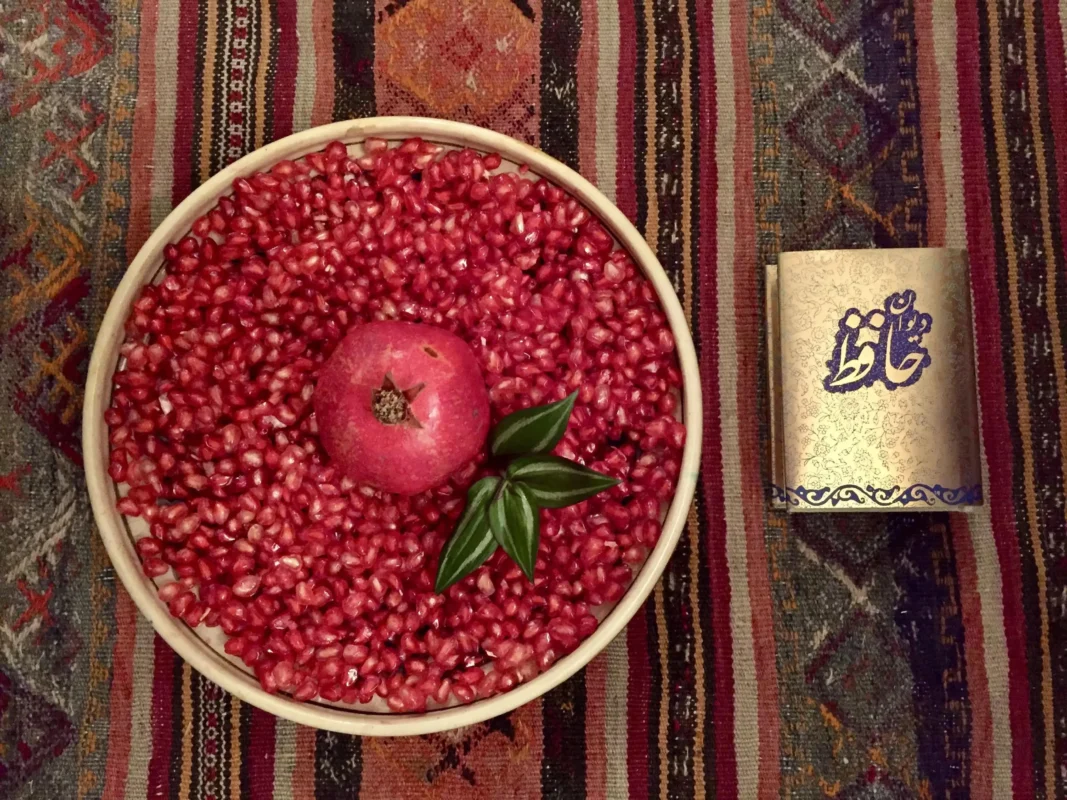
That combination of literature, reflection and conversation is one reason Hafez has become such a natural part of Yalda.
Yalda and the importance of family
Perhaps the most enduring part of Yalda is not a particular food, poem or symbol, but the importance placed on gathering.
Older relatives often play an important role in passing customs and stories to younger generations. A child may remember the same Yalda foods their grandparents prepared, hear poems that have been part of the family for decades and gradually come to understand why the occasion matters.
For Persian families living outside Iran, this intergenerational aspect can carry even greater significance. A child growing up in London may have little day-to-day contact with the places where their parents or grandparents grew up, but Yalda can create a tangible connection with that heritage.
It is not necessarily about recreating the past exactly as it was. It is about giving the next generation something meaningful to carry forward.
How is Yalda celebrated in the UK?
Yalda has travelled with Persian communities around the world, and celebrations in Britain naturally reflect the lives of the people taking part.
A family in London might gather in a modern flat rather than a traditional Iranian home. Relatives in another country may join through a video call, while children move comfortably between Persian and English during the evening. Traditional foods may be prepared at home or purchased from a local Persian shop, and poetry might be read in Persian alongside an English translation.
None of these changes make the celebration less meaningful.
Living traditions inevitably adapt when people move, marry, raise children and build new communities. The important thing is not to reproduce every detail of a celebration from another place or another generation, but to retain the ideas that make the tradition worth continuing.
Is Yalda a religious celebration?
Yalda has historical connections with ancient Iranian beliefs and traditions surrounding the sun, seasonal change, light and darkness. Today, however, it is widely celebrated as a cultural tradition by people with different religious backgrounds and levels of religious observance.
For many families, the emphasis is on cultural identity and spending time together rather than religious practice. This has also helped Yalda travel successfully across communities and generations, allowing people to celebrate it in ways that reflect their own beliefs and circumstances.
Is Yalda the same as Christmas?
Yalda and Christmas take place around the same time of year, but they are distinct traditions with different histories and meanings. Yalda is associated with the winter solstice and Persian cultural traditions surrounding the longest night of the year, while Christmas is a Christian celebration centred on the birth of Jesus Christ.
Some Persian families living in the UK celebrate both, and there is no contradiction in doing so. Modern families often bring together traditions from different parts of their lives, particularly when they live in multicultural societies.
Yalda does not need to compete with Christmas. It simply offers another way of marking the winter season.
How has Yalda changed in modern life?
Like every living cultural tradition, Yalda has changed as the lives of the people celebrating it have changed. Families may now be separated by thousands of miles, and technology has made it possible for relatives to participate from different countries. Traditional foods might be prepared differently, bought ready-made or combined with dishes that have become part of a family’s new home.
Even the way younger generations discover the celebration is changing. A child might first hear about Yalda from their grandparents, encounter it at a community event or discover its history online before taking part in a family gathering.
These changes don’t necessarily weaken the tradition. In many cases, they are what allow it to continue.
Yalda and contemporary Persian jewellery
The symbols associated with Yalda have naturally found their way into contemporary jewellery. Pomegranates, Persian motifs, calligraphy and references to poetry can all be reinterpreted in ways that connect heritage with modern design.
The key is not to reproduce the past literally. A contemporary piece can take one recognisable idea and transform it into something that feels completely at home in modern life.
That philosophy is reflected in ZAR Jewellery, where Persian heritage, nature and cultural influences are interpreted through contemporary jewellery. A pomegranate-inspired ring can reference Yalda without being restricted to December, while a Persian motif or poetry-inspired design can carry a cultural connection without looking overtly traditional.
For the wearer, that can make the connection much more personal. The symbolism becomes part of something they own and wear rather than simply something they see during a particular celebration.
Why Yalda still matters
It would be easy to assume that traditions such as Yalda become less relevant as families become more modern and geographically dispersed. In reality, the opposite can happen. When people live away from the places where their traditions began, cultural celebrations can become an important way of maintaining a connection with family history and identity.
Yalda provides a reason to gather at a particular time each year. It gives older generations an opportunity to pass down memories and gives younger people a way to understand a part of their heritage that might otherwise feel distant.
It also offers something that has very little to do with geography or culture: a reminder that difficult periods eventually change. The longest night does not last forever, and the return of light begins almost imperceptibly.
Perhaps that is why Yalda remains so powerful.
The longest night is really about what comes afterwards
Yalda begins with darkness, but it is not really a celebration of darkness. It is a celebration of what people do while they wait for the light to return.
Families gather around a table, share food, read poetry and tell stories. They remember relatives who may no longer be there and create memories for the people who will carry the tradition forward. For one evening, the longest night becomes an opportunity to slow down and appreciate the people around us.
Then, gradually, the days begin to lengthen.
That simple movement from darkness towards light is one reason Yalda continues to resonate across generations and borders. Whether it is celebrated in Tehran, Shiraz, London or somewhere else entirely, the details may change while the central idea remains familiar.
The night will pass. The light will return. What people share while they wait can remain with them for much longer.
Frequently Asked Questions
What is Yalda Night?
Yalda Night, also known as Shab-e Yalda or Shab-e Chelleh, is a Persian cultural celebration associated with the winter solstice and the longest night of the year. Families traditionally gather to share food, poetry, stories and time together.
When is Yalda Night?
Yalda is celebrated around the winter solstice, usually on the evening of 20 or 21 December. It traditionally marks the final night of autumn and the beginning of winter.
Why do Persians celebrate Yalda?
Yalda marks the winter solstice and the beginning of the gradual return of longer days. It is also an important cultural occasion for family gatherings, poetry, food, storytelling and passing traditions between generations.
Why are pomegranates associated with Yalda?
Pomegranates are traditionally served during Yalda and their deep red colour has become an important part of the visual character of the celebration. The fruit also has a much wider place in Persian culture, art and symbolism.
Why is Hafez read on Yalda?
Hafez is associated with Yalda through Fal-e Hafez, a tradition in which people open the Divan of Hafez and read a selected poem, often interpreting it in relation to a question, hope or personal situation.
How is Yalda celebrated in the UK?
Persian families in the UK celebrate Yalda in many different ways, from large family gatherings to intimate evenings at home. Modern celebrations may combine Persian traditions with British life while retaining the central themes of family, food, poetry and togetherness.